Article
Why Cheap AI Websites Fail
A cheap AI website can look finished in an afternoon. It rarely ships with the SEO, interface design, marketing, or WCAG work that keeps a real business findable and usable. Here is what usually fails, and what to do next.
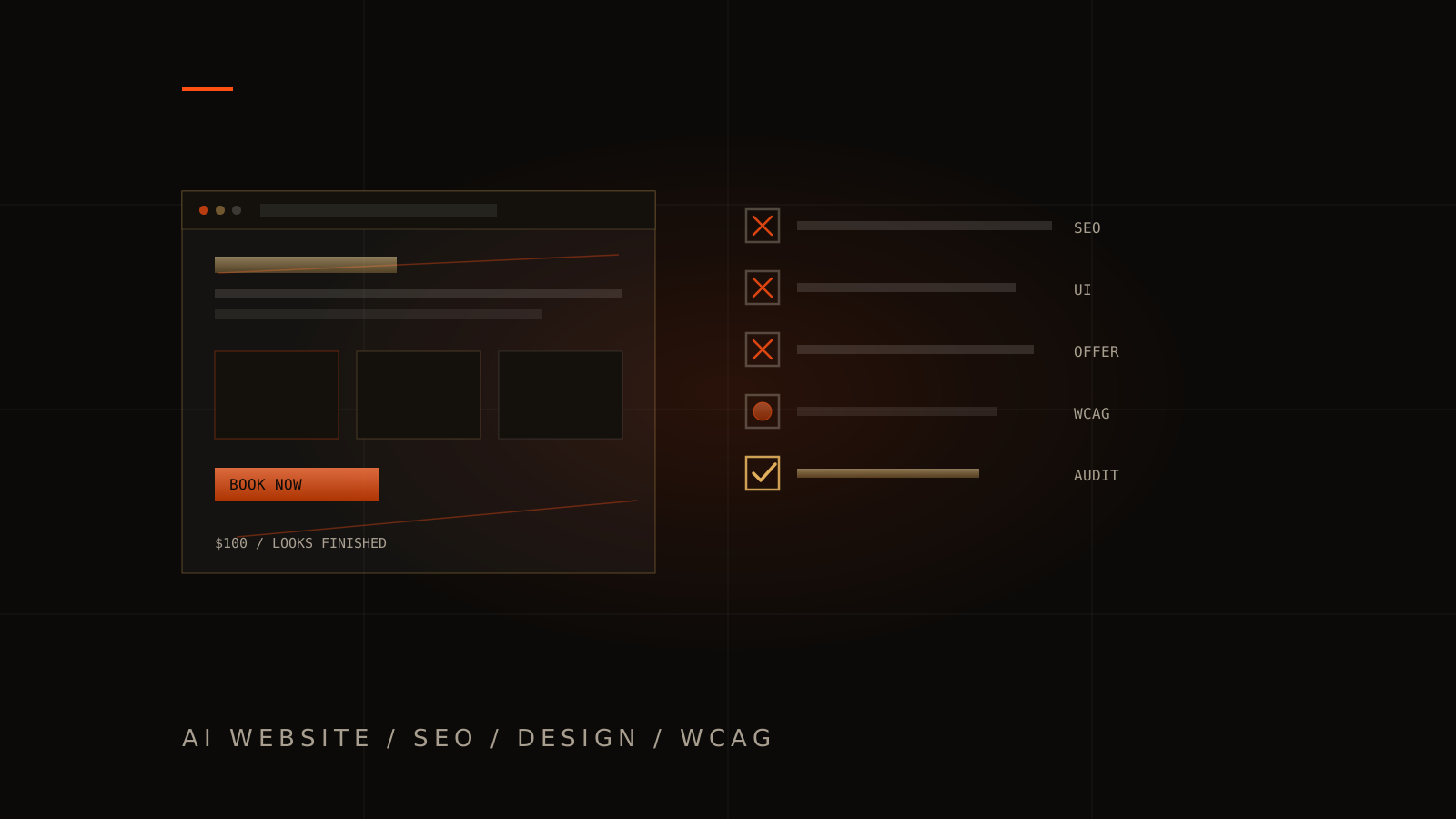
Dear business owner who just paid a hundred dollars for a ChatGPT website,
The person who built it did not teach the model SEO, interface design, marketing, or accessibility. The model did not learn those from a weekend of prompts either. What you received can look finished on a laptop. What you published is often invisible to search, unusable for a share of your customers, and thin enough that it never earns an enquiry.
That is not a taste argument. WCAG and disability discrimination rules do not care who wrote the markup. A site that cannot be used with a keyboard or a screen reader is both a customer problem and a legal risk. In the United States, a cottage industry of accessibility demand letters already treats cheap websites as inventory. In Australia the Disability Discrimination Act 1992 is the statute, and WCAG is the technical standard people use to argue the case.
The lesson is blunt. You get what you pay for. Sometimes you get less: a brochure that costs you rankings, trust, and a complaint you never budgeted for.
If the site was generated in Cursor, Lovable, Bolt, v0, Replit, Copilot, or ChatGPT and you still have the source, start with a vibe coding audit. If you would rather replace the brochure with a search-ready build, see website design in Melbourne. Either way, book a Discovery Session before you spend another dollar on prompts.
What a cheap AI website usually ships
An AI-generated website is a site assembled mostly by a language model, directed in natural language, often by someone selling speed. The output can include a homepage, a contact form, and a deploy to a free host. It can also include:
- One generic title tag and a meta description copied from the hero sentence
- Stock layout: identical rounded cards, rainbow accents, and type that never belongs to the brand
- No offer, no proof, no tracked call to action, and no analytics you can read
- Colour contrast that fails, images without text alternatives, and controls that only work with a mouse
The site looks done because the happy path works on the builder's screen. A production website has to work for strangers: people who search, people who skim on a phone, people who cannot see the ember button, and people who will never guess that the menu is a hover-only trick.
SEO: looking published is not being findable
Search engines do not rank effort. They rank pages that answer a query, load quickly, and look like a real business. Cheap AI sites fail that test in predictable ways.
Thin, duplicated copy
The model writes a paragraph that could sit on any plumber, clinic, or cafe in any city. There is no suburb page, no service page with a distinct job, and no FAQ that matches what people type. Google already has a million of those paragraphs. Yours will not be the one it keeps.
No technical foundation
Missing or duplicated title tags. No canonical. No Organization or LocalBusiness schema. Images dumped at full resolution. A single JavaScript bundle that paints late on mobile. Heading levels used as decoration. The crawl may succeed. The ranking will not.
No local or commercial intent
Customers search for the service plus the suburb, or the service plus a problem. A one-page AI brochure answers neither. Paid ads then become the only way anyone arrives, which is how a $100 website becomes an expensive lead tax.
A proper build ships search-ready: semantic structure, schema, on-page SEO, and a sitemap you can defend. Ongoing SEO and marketing is how those foundations turn into enquiries. We wrote the practical version for managers in SEO for Melbourne small businesses.
UI design: the tell of a prompt, not a brand
You can spot a cheap AI website in a few seconds. Multi-colour "spectrum" palettes. Grids of identical glass cards. Motion that fades every block in the same way. Type that never includes a second voice. The interface is a collage of whatever the model has seen most often, not a decision about your customers.
Interface design is not decoration. It is the path from a stranger to a phone call. Cheap AI sites typically miss:
- A visual hierarchy that tells you what to do next
- Type large enough, and contrast strong enough, to read outdoors
- Touch targets that work with a thumb, not only a cursor
- Forms that name errors, keep focus, and do not trap a keyboard user
- Motion that respects
prefers-reduced-motioninstead of assuming everyone enjoys a scroll circus
That last point is accessibility and design in the same breath. If you want the conversion argument for motion done properly, read why interactive design converts. If you want a site that does not look like every other generated template, the comparison is custom versus Wix or Squarespace.
Marketing: a brochure is not a salesperson
A website has one job: turn attention into a conversation. Marketing is the work of choosing who that conversation is for, what you ask them to do, and how you know it happened. A language model will invent a tagline. It will not invent a position in the market.
Cheap AI sites commonly ship with:
- No clear offer or price signal, so the visitor cannot tell if you are for them
- No proof: reviews, case work, licences, or a face that belongs to the business
- A contact form that emails a personal Gmail and never reaches a CRM
- No analytics, or a tag dumped in with no events for phone, email, or booking clicks
That is how owners conclude "the website does not work" after three quiet months. The site was never given a job. Published website packages at this studio start at $399 + GST for a five-page custom build, which is still cheap next to a year of ads spent on a page that cannot convert. Detail: how much a website costs in Melbourne.
Accessibility: WCAG does not care who wrote the HTML
This is the part the $100 quote never mentions. Online experiences have to be usable by people with disability. The technical bar most lawyers, auditors, and procurement teams point at is the W3C Web Content Accessibility Guidelines. WCAG 2.2 is the current recommendation.
AI-generated markup fails the basics because the prompt asked for a look, not a usable document:
- Contrast. Ember-on-ink can pass when you choose the values. Pastel text on a photo hero usually fails.
- Text alternatives. Decorative SVGs marked as content. Product photos with empty
alt. Icon-only buttons with no name. - Keyboard. Menus that open on hover only. Focus rings removed "for aesthetics". Dialogs that do not trap or restore focus.
- Structure. A visual heading that is a styled
div. Landmark regions missing. Skip links never added. - Forms. Placeholders instead of labels. Errors that appear only as a red border. Timeouts with no warning.
Australia: Disability Discrimination Act, not a US import
If your customers are in Australia, the relevant statute is the Disability Discrimination Act 1992. The Australian Human Rights Commission publishes web access advisory notes that treat WCAG as the practical measure. Government and many enterprise buyers already require WCAG conformance in tenders. A small business is not invisible to a complaint just because it is small.
United States visitors and the demand-letter industry
If you sell to, or even clearly invite, people in the United States, you can inherit US accessibility exposure on top of Australian duties. The US Department of Justice publishes web guidance under the ADA. Separate from any court outcome, there is a well-known pattern of serial demand letters aimed at sites with obvious WCAG failures. A cheap AI website is an easy target because the failures are obvious: no alt text, no keyboard path, contrast that fails a 30-second check.
This page is not legal advice and a studio review is not a certificate. It is a map of what usually breaks, and why "the model said it was accessible" is not a defence. If you already have an AI-generated site or app in the wild, the vibe coding audit is the product-layer review: repo, hosting, and the surfaces that decide whether strangers can use what you shipped. Sibling context for apps: why vibe-coded apps fail.
Cheap AI site versus a production website
| Surface | What the $100 prompt ships | What a production site needs |
|---|---|---|
| SEO | One generic title, thin copy, no schema | Unique titles, service pages, schema, a crawl you can defend |
| UI design | Template cards and a palette the model likes | Brand type, hierarchy, mobile targets, reduced-motion |
| Marketing | A slogan and a form to someone's inbox | Offer, proof, tracked CTAs, analytics you can read |
| Accessibility | Looks fine with a mouse on one laptop | Keyboard, contrast, names, structure, WCAG-minded markup |
| Ownership | A hosted preview you cannot export cleanly | Source you own, hosting you control, a human who can change it |
When the "website" is actually a generated web app with accounts, payments, or personal data, the gap is larger. That is the $200 + GST standard vibe coding audit: seven surfaces, ranked written report, rescue quoted after. We do not certify WCAG or give legal advice. We tell you what is broken in plain English.
What to do if you already bought one
- Stop prompting over the top of it. Another ChatGPT pass will add more markup, not a heading outline or a contrast system.
- Decide whether you have source. A Git repo, or an exportable Lovable / Bolt / v0 project, can be audited. A locked template with no files is a rebuild.
- Book Discovery. We will say whether the honest next step is a vibe coding audit, a scoped rebuild on website design Melbourne packages, or both.
If the builder used AI and called it a custom studio, you still own the risk. The invoice does not transfer WCAG duty, SEO debt, or the phone that never rings.
If you already know the brochure is the wrong product, the next question is usually timing or handover, not another prompt. Read when your AI build needs a professional when the hire trigger is industry-shaped (forms, Shopify, SaaS, clinic, trades). Read finish an AI-built website or app when you need a developer-ready brief: what works, what fails, and what a customer must complete before anyone quotes a completion stage.
If the bigger question is whether AI, now officially Super Intelligence in the US, should sit under the whole business and not just the brochure, read Super Intelligence for business. This page stays on the brochure.
Cheap AI website FAQs
Is a ChatGPT website illegal?
Using AI to draft a site is not illegal. Shipping a public site that people with disability cannot use can breach disability discrimination law, and it can attract complaints or demand letters depending on who your users are. The tool is not the issue. The published experience is. This is not legal advice. Speak to a lawyer if you have a live complaint.
Does ADA apply if my business is in Australia?
Australian customers sit under the Disability Discrimination Act and related state law, with WCAG as the usual technical reference. ADA is a United States statute. It can still matter if you clearly offer services to people in the US. Map your users first. Guessing the regime second is how people get this wrong.
What is WCAG in plain English?
WCAG is a W3C standard for making web content usable by more people: perceivable, operable, understandable, and robust. Version 2.2 is the current recommendation. Conformance has levels. Most procurement language asks for Level AA. A model that "adds aria labels" is not the same as meeting that bar.
Can you fix my existing AI-generated website?
Sometimes. Salvageable structure gets hardened: titles, contrast, labels, schema, and a real information architecture. Generated spaghetti with no source and no heading outline is often cheaper to rebuild. That call is the point of Discovery, and of a vibe coding audit when a repo exists.
How much does a proper website cost compared with $100?
Published packages here start at $399 + GST for up to five custom pages, $1,099 + GST for up to ten, and $4,799 + GST for up to 25. A vibe coding audit of one eligible AI-generated app is $200 + GST. Those numbers buy structure, SEO foundations, and a human who will own the result. They are still less than a year of ads on a page that cannot convert, or a single accessibility complaint.
Ready to replace the brochure before it costs you more?
Book a Discovery Session. Bring the live URL. We will say whether to audit, rebuild, or both. Service detail: vibe coding audit and website design Melbourne.