Case study
Autopac Systems Catalogue
Autopac Systems supplies weighing, packaging, and inspection equipment from Melbourne. Alphesda rebuilt autopacsystems.com as a searchable Nuxt catalogue with a Firebase admin, so buyers can specify a machine and send an enquiry.
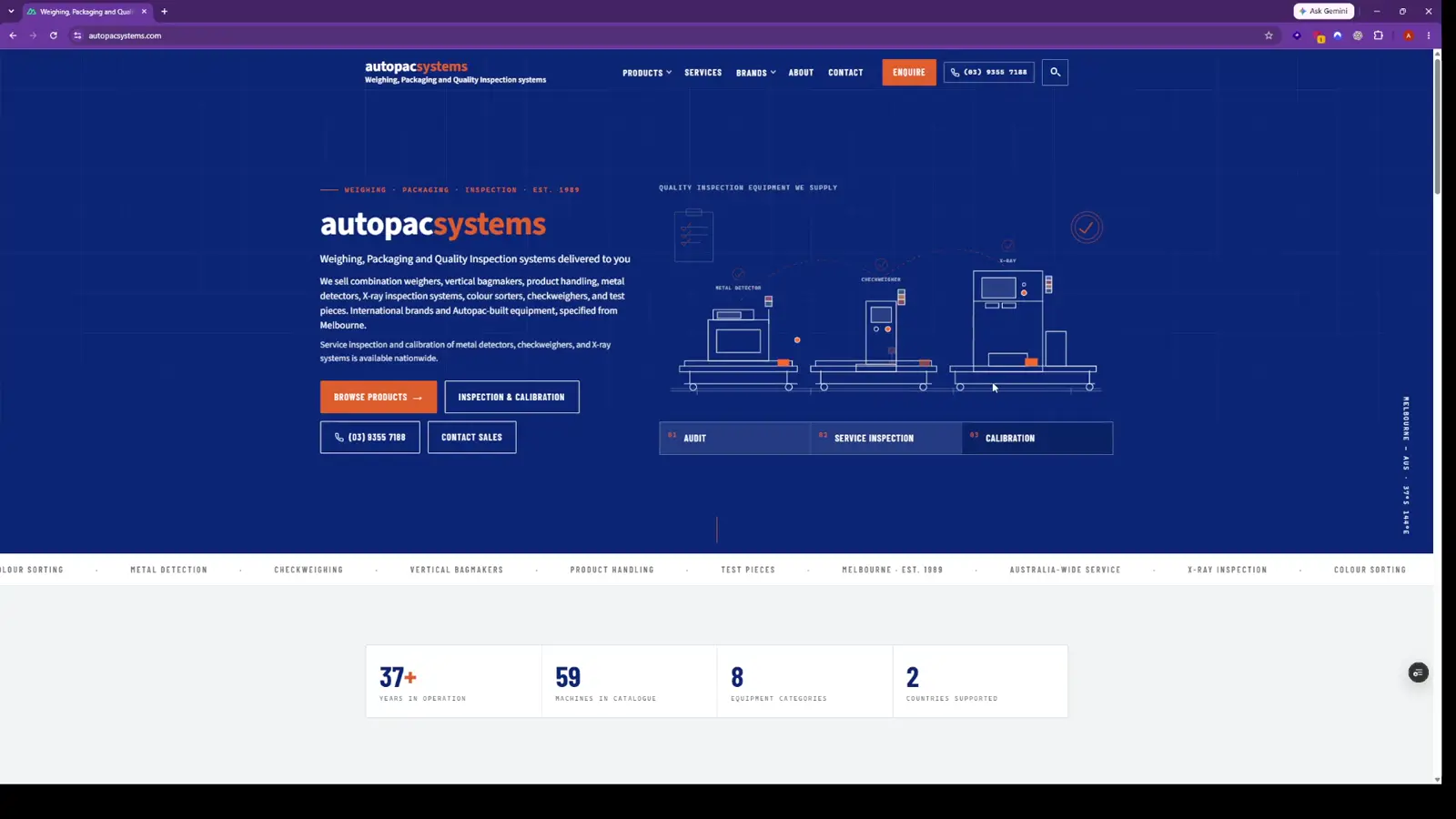
Autopac Systems supplies weighing, packaging, and quality inspection equipment from Melbourne. Established in 1989, the company sells combination weighers, vertical bagmakers, product handling, metal detectors, X-ray inspection, colour sorters, checkweighers, and test pieces, then supports those lines with training, calibration, and service across Australia and New Zealand.
Alphesda Interactive designed and built the public catalogue at autopacsystems.com. Buyers can search machines by category and brand, open a specification, and send an enquiry. Staff keep products, images, and datasheets current in a Firebase admin, without waiting on a developer for every brochure change.
The brief
Replace a legacy brochure site with a catalogue that still feels like an industrial supplier. Buyers needed categories, partner brands, specifications, and a clear way to ask for a price or a demo. Staff needed to edit products themselves, and old addresses had to keep working so search traffic was not thrown away.
There is no shopping cart. Autopac specifies equipment for a production line, then follows up from the Coburg North facility. The site's job is to make that enquiry precise. If your catalogue or service offer is stuck in a theme that cannot keep up, book a Discovery Session and we will map the smallest rebuild worth shipping.
A catalogue structured like a production line
The homepage opens on the offer Autopac actually sells: weighing, packaging, and quality inspection systems delivered from Melbourne. Below that, a schematic shows how a typical line is built. Hopper and elevator, multihead weigher, vertical bagmaker, offtake conveyor, metal detection, checkweighing, and X-ray. Each stage links into the live category, so a plant manager can start from the process instead of guessing a model name.
Eight public categories hold 59 machines across six brands: Now Systems, PAM, AMD, Kenwei, Foodman, and Autopac's own equipment. Header search covers products, categories, and brands. Product pages carry specifications, datasheets where the manufacturer has supplied them, and an enquiry form with that machine already selected. That is the same class of work as our website design and development, aimed at a technical catalogue rather than a five-page brochure.
The same catalogue on a phone
Engineers and buyers open this between the office and the plant. Navigation collapses into a drill-down menu, search stays one tap away, and the packaging-line drawing stacks into readable stages instead of a desktop rail squeezed onto a narrow screen.
Call, enquire, and contact stay in reach. Service pages cover onsite training, inspection and calibration, and customer service agreements, with sales and service reached from the Melbourne facility at 38 Trade Place, Coburg North.
An admin the catalogue can live in
Editors sign in to an admin with Firebase Auth. They manage products, categories, brands, images, datasheets, and the enquiry inbox, and they can invite or revoke teammates. Public pages read the Firestore catalogue on the server, with a packaged catalogue snapshot as the fallback if the live source is unavailable. A save shows on the next request, so a new machine does not wait on a full site rebuild.
Enquiries are validated and stored, then emailed to the buyer and to the Autopac sales desk. That operator layer is why this also sits with our custom software work. The public site is the shopfront. The admin is how the catalogue stays true.
Technical architecture
- Public site: Nuxt 4 on Vercel. Catalogue HTML is rendered on the server so category and product pages are readable by search engines.
- Catalogue: Firebase Firestore and Cloud Storage, with a catalogue snapshot as seed and fallback.
- Admin: signed-in Nuxt admin, Firebase Auth with an admin claim, plus team invite and revoke.
- Leads: a server enquiry route with validation and rate limiting. Mail goes to the enquirer and to sales.
- Search and navigation: search across products, categories, and brands. Desktop menus and a mobile drawer.
- Legacy addresses: redirects for renamed products and mapped paths from the previous site, so a bookmark or a search result does not land on a dead page.
Keeping those addresses stable is the same discipline we describe in redesigning a website without losing SEO. For how we use Firebase on other builds, see what Firebase is good for.
What we delivered
- Live catalogue at autopacsystems.com, covering 59 machines in 8 categories.
- Homepage drawings for a packaging line and for inspection and calibration.
- Product, category, brand, services, about, and contact pages, with enquiry forms on contact and on each product.
- Firebase admin for catalogue edits, media, datasheets, enquiries, and team access.
- Search, phone navigation, and redirects from the previous site.
Need a catalogue, a service site, or the admin behind them? Explore website design and development, custom software, and SEO for Melbourne businesses, or book a free Discovery Session and leave with a clear build plan.