Staff re-enter orders
When web orders do not reach the system that picks, packs and invoices them, the team spends time rekeying and hunting down exceptions.
Flagship service / Melbourne, Australia
We design and build enterprise ecommerce for Australian retailers, wholesalers and distributors. Connect your catalogue, customer pricing, stock and orders to the systems your team uses, without replacing what already works.
What gets in the way
Before
Big-bang migration
After
Rehearsed cutover
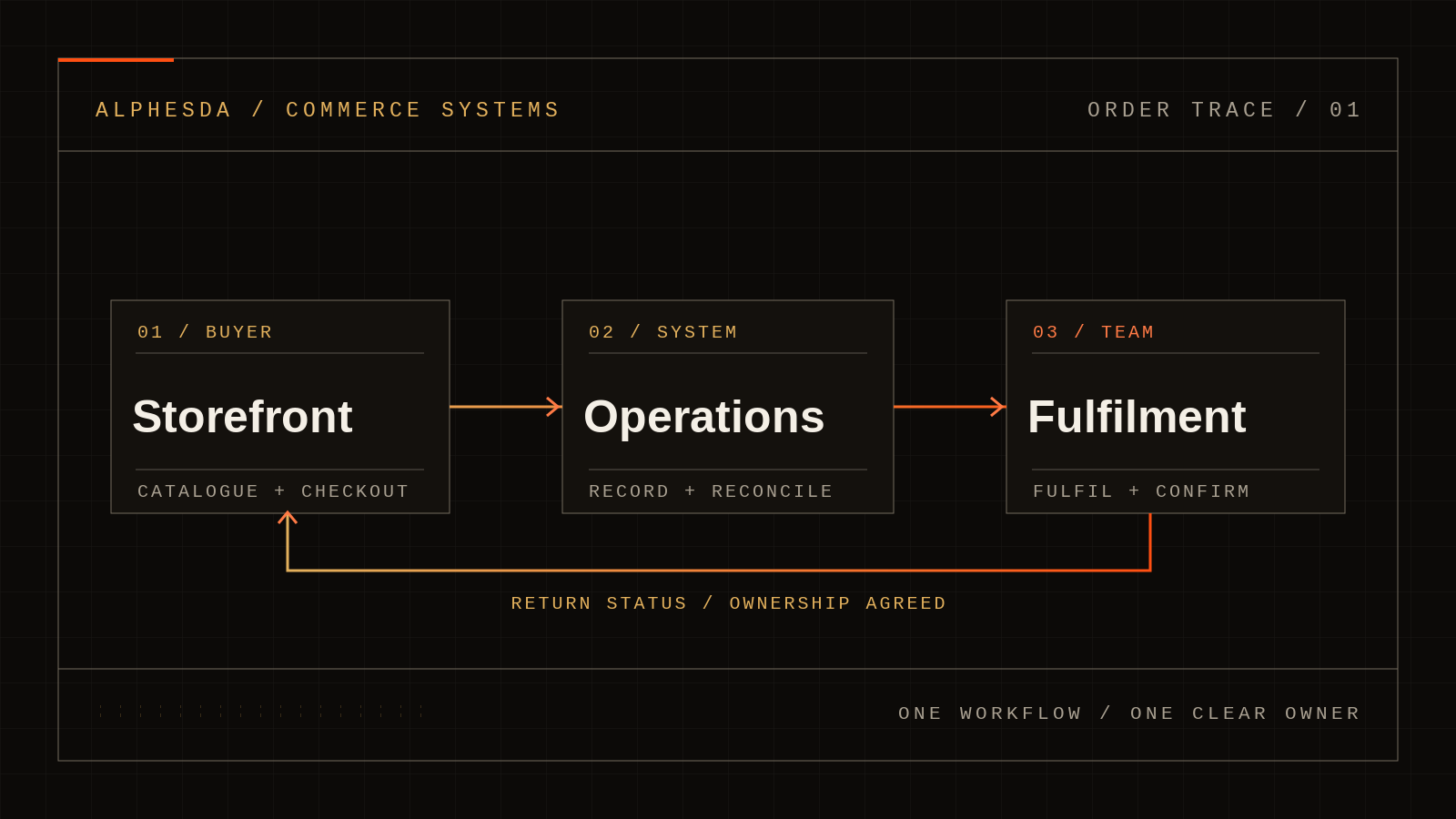
When web orders do not reach the system that picks, packs and invoices them, the team spends time rekeying and hunting down exceptions.
Buyers see numbers that do not match what you can deliver. Decide which system owns each field, how quickly it must update and how to spot a mismatch.
Build around the parts that already work. Prove the first workflow, rehearse cutover and preserve useful catalogue URLs before moving more traffic.
Built by Alphesda
Our published work includes a custom public storefront, Stripe checkout and customer and staff applications sharing commerce data. This is evidence of the delivered workflows, not a commercetools or NetSuite implementation.
Inspect the Luxora Hair build ↗We built a searchable machinery catalogue, staff publishing and product-specific enquiries. It is an enquiry-led catalogue, not a checkout implementation.
Inspect the Autopac catalogue ↗Three implementation paths
We compare what you can keep, what you need to connect and what a new platform would cost to own. A vendor shortlist is a decision, not the starting assumption.
Start with a managed platform such as Shopify Plus when catalogue, checkout and B2B requirements fit its capabilities. Reuse the platform where possible. Confirm actual plan features, integration limits and any ongoing app costs before recommending it.
If Oracle NetSuite already owns your agreed inventory or finance records, we map ownership field by field and plan how orders, stock and related data move. SuiteTalk REST or an approved connector can be considered once record support, permissions, volumes and reconciliation are understood.
For multiple brands, regions or complex trade rules, assess an API-first platform such as commercetools. Decide which capabilities belong in commerce, product information, search, fulfilment and payment systems. Where specialist co-delivery is needed, define responsibilities and costs before implementation.
Plan accessible storefront UX, catalogue and search, trade accounts, checkout and fulfilment exceptions together. Define how staff see failures, reconcile orders and recover from a problem before expanding the rollout.
Fit
You have an established catalogue, sales history and fulfilment process. Preserve useful product URLs and proven integrations while addressing where customers or staff get stuck.
Account-based pricing, quotes, order approvals and repeat ordering often matter more than decoration. We map the buyer journey alongside your sales and operations teams.
Keep your ERP work distinct from the storefront programme. If you need a wider configuration or operating-systems brief, start with our independent NetSuite service.
Explore NetSuite setup and integration ↗How it works
We start with a scoping conversation and quote a bounded discovery engagement. It maps your workflows, system ownership, migration risks, platform options and operating costs. You get an implementation brief and an agreed first outcome before committing to a build.
Choose a measurable workflow, such as getting paid orders into the ERP with the correct SKUs and fulfilment state. Agree the benchmark, build a bounded release and test retries, exceptions, accessibility and reconciliation in the appropriate test environment.
Rehearse cutover and rollback, review the migration and redirects, and confirm staff can run the new workflow. Agree launch support, monitoring, ownership and the next improvements in writing.
Fixed delivery price for one storefront once scope is confirmed in writing: storefront design and development, agreed migration, catalogue and checkout setup, and one agreed standard stock, order or ERP connection. Includes testing, launch and handover. Architecture discovery is quoted separately. Platform licences, subscriptions, transaction fees, extra brands or markets, ERP implementation, bespoke middleware and advanced B2B rules are separate.
Discuss your ecommerce projectProof
Published examples of storefront, catalogue and operating-workflow design. These are not claimed as implementations on the named enterprise platforms.
Questions
Not necessarily. Discovery compares extending what works, replacing a single weak layer and replatforming. Decide by looking at data quality, the required workflows, ongoing operating costs and migration risk.
A$72,000 is the fixed delivery price for the defined one-storefront package once scope is confirmed in writing. Discovery, licences, subscriptions, transaction fees, additional scope and ongoing support are separate. Projects outside the package are quoted on their own requirements.
Alphesda provides independent services. References to Shopify Plus, Oracle NetSuite and commercetools describe platform options, not vendor affiliation, partnership or certification. If a specialist is required, we agree their role before work starts.
Send your current storefront URL, the main systems involved, your markets or customer types and one workflow to improve. An approximate catalogue size helps. Do not send live credentials, customer records or payment data in the enquiry.
Official guidance
Next step
Tell us what you sell, the systems you run and where work breaks down. We will discuss fit and whether a paid architecture discovery is the right next step.