Enterprise database migration and modernisation · Australia

Move from SQL Server to PostgreSQL with confidence.

Database modernisation without guessing at the cutover.

Your database underpins orders, finance, reporting and the applications your people depend on. Alphesda starts with an assessment of your Microsoft SQL Server estate and builds a staged migration plan for PostgreSQL, including Amazon RDS for PostgreSQL or Aurora PostgreSQL where suitable. We scope the conversion, data movement and application changes together.

Assessment firstPostgreSQL · AWSRehearsed cutover
SQL Server to PostgreSQL Migration

What gets in the way

A database move is a business change, not a file copy.

Costs and dependencies have accumulated

Licensing, hosting, reporting jobs and an ageing application stack can make a database hard to change. Compare ongoing costs and support constraints with the work needed to move. Keeping SQL Server may be the right answer.

Different engines behave differently

Stored procedures, T-SQL, data types, collations, identity columns, reports and application drivers may need engineering work. Discover these dependencies before committing to a target.

The business cannot afford surprise downtime or missing records

Agree which workflows matter most, the maximum tolerable interruption and loss of recent data. Plan how to prove business totals, permissions and application behaviour before switching traffic.

Migration engineering

From assessment to a controlled release.

Database assessment and target selection

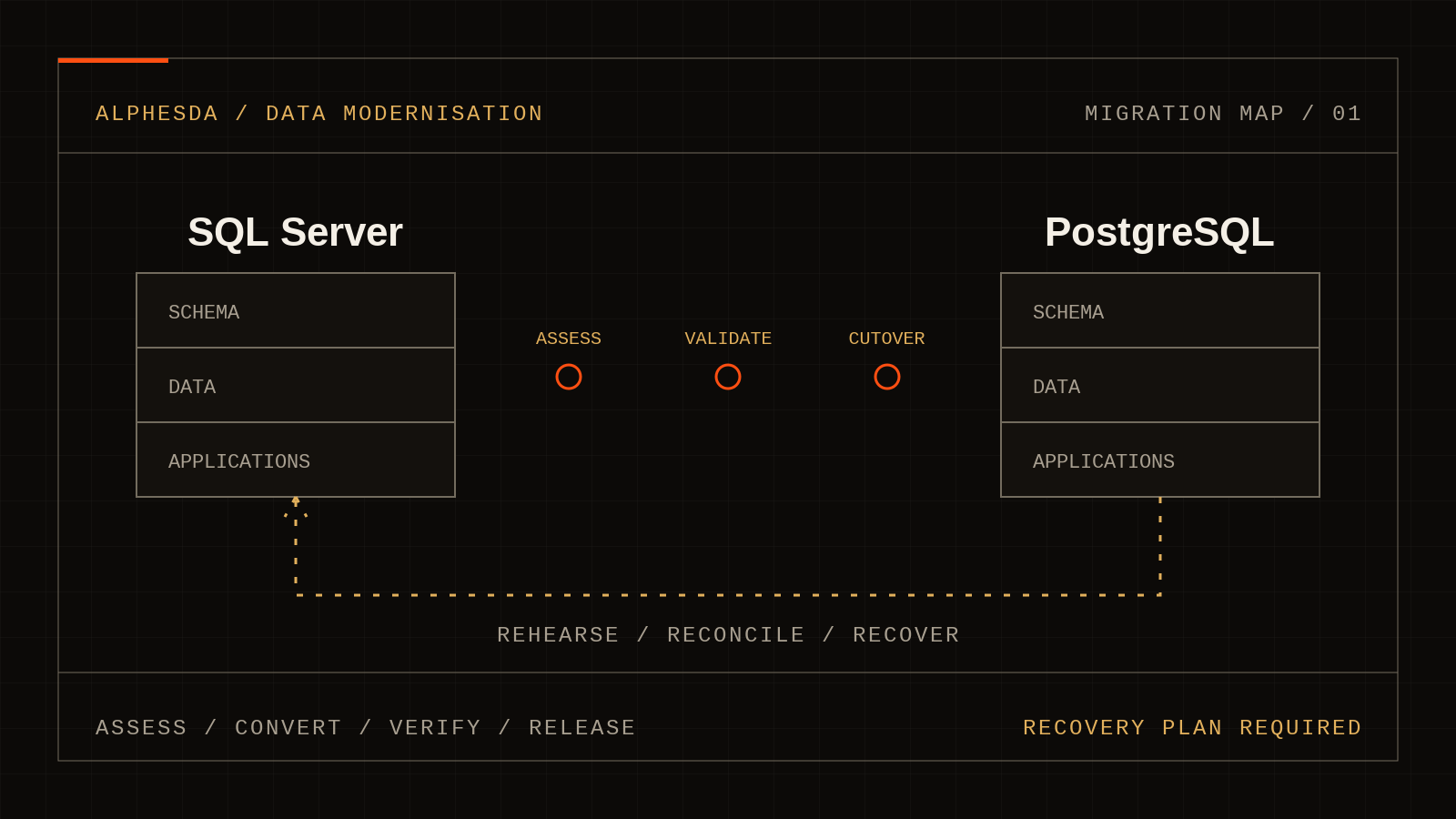
Inventory the estate, SQL Server editions and versions, schemas, database size, change rate, integrations, jobs, permissions and critical queries. Compare PostgreSQL, Amazon RDS for PostgreSQL and Aurora PostgreSQL with retention or upgrade options. Produce an action register, effort range and decision-ready architecture.

Schema and application conversion

Assess DMS Schema Conversion or AWS Transform for supported SQL Server modernisation paths, where appropriate. Review conversion reports and manually adapt stored procedures, constraints, SQL semantics, jobs and application queries or drivers that cannot translate reliably. Do not treat generated code as production-ready.

Data migration and reconciliation

Where supported, use AWS Database Migration Service (DMS) for an initial load and change data capture (CDC). Validate row counts and representative records, investigate mismatches and reconcile business totals independently, including critical reports and exceptional records. Confirm supported editions, types and endpoint constraints before selecting tools.

Performance and operational readiness

Benchmark representative queries against agreed expectations, review indexes, transactions, connection pooling, scheduled jobs, backups, recovery, observability and access. Validate least-privilege permissions and data handling in controlled environments before production.

Cutover, rollback and handover

Rehearse the cutover on a representative copy, monitor replication lag and agree the write-stop window and go/no-go criteria. Document how to reconcile writes made after switching, recover or roll back and resume operations safely. Agree operational support in writing.
Fit

Who this is for

Technology leaders assessing a move away from SQL Server

You need an evidence-led recommendation, a migration plan and a cost comparison rather than a promise that PostgreSQL will automatically cost less.

Retail, wholesale and operations platforms

Orders, stock, fulfilment and reporting must stay consistent as the underlying platform changes.

Explore enterprise ecommerce ↗

Teams with Oracle or other legacy databases

Oracle Database is a separately assessed specialist scope, not an automatic extension of a SQL Server quote. We assess dependencies, licensing, tooling, specialist co-delivery and acceptance criteria before proposing implementation. Oracle Database migration is distinct from Oracle NetSuite integration.

How it works

A process without black boxes

  1. Paid migration readiness assessment

    Start with a scoping conversation. Agree a bounded assessment and access arrangements. Deliver an inventory, conversion action list, options and costs, risk register, recommended pilot, critical tests and draft milestones.

  2. Prove a representative workload

    Agree a pilot and use an authorised test environment. Convert representative schemas and application paths, test data movement, reconcile key records and benchmark performance. Resolve incompatibilities and update the implementation scope before committing further.

  3. Rehearse and review the production change

    Agree the release window, recovery objectives, owners, rollback plan and acceptance criteria. Run a dress rehearsal and obtain sign-off. Only then move the agreed production workload with monitoring and defined support.

Start with a migration assessment, not a production move.

We quote a bounded readiness assessment first. Implementation, AWS usage, licensing, specialist services and ongoing support are separately scoped. Send non-sensitive details of your estate and objectives; never send live credentials or customer data through the enquiry form.

Request a migration assessment

Questions

Straight answers

Can you move Microsoft SQL Server to PostgreSQL on AWS?

We assess and scope SQL Server to PostgreSQL migration projects, including RDS and Aurora PostgreSQL. We first verify source and target support, application compatibility, access and delivery responsibilities. For complex estates we may propose specialist co-delivery.

Does AWS DMS automatically convert everything?

No. Schema conversion and data migration are different tasks. DMS Schema Conversion produces a conversion assessment and identifies items requiring manual work. Business logic, application SQL, permissions, jobs and testing still need a scoped plan.

Can you guarantee zero downtime or lower costs?

No. Data volume, change rate, application dependencies and recovery requirements determine the achievable window and cost. We agree measurable objectives, test them and plan rollback before a production release.

Can you migrate Oracle Database as well?

Oracle Database is a separately assessed specialist scope. Editions, data types, procedural code, licensing and dependencies vary. The first deliverable is a recommendation and scope, not an unqualified migration promise.

How much does a migration cost?

The initial assessment is quoted against the estate and required deliverables. The implementation proposal follows the assessment and includes agreed engineering stages, exclusions and responsibilities. AWS usage, vendor licensing and specialist support are separate.

Are you affiliated with AWS, Microsoft or Oracle?

Alphesda offers independent assessment and implementation support. We do not claim vendor partnership or certification. Vendor services and specialist support are separate.

Next step

Make your next database move _a measured decision_.

Tell us which database and applications you run, approximate scale and business objectives. We can establish the right first assessment without receiving connection strings, credentials or production records.